
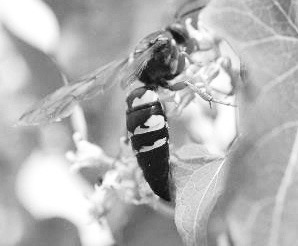
They may look brilliant to the human eye, but cicada killer wasps are certainly no ally to the six-legged, five-eyed cicada whose steady buzz can be heard on most summer nights in Kansas.
Kansas State University horticulture expert Matt McKernan said it is common for cicada killer wasps to build nests in lawn and garden areas around the home.
“At about two inches long, cicada killers are an intimidating wasp. They have reddish-brown-colored wings, head and legs and a black abdomen with wide, yellow stripes,” McKernan said.
Females have a stinger that is used to paralyze their prey. McKernan said they rarely sting people unless provoked. Males are smaller and do not have a stinger.
“Although males tend to be more aggressive, they are not harmful since they cannot sting you,” McKernan noted. “Male cicada killers establish territories near a female’s nest, and fly around patrolling for intruders. Once they determine you are not a threat, they tend to fly off.” “Females are responsible for locating cicadas and paralyzing them with their stinger. She then carries the cicada back to her underground burrow. Each burrow contains three to four cells, each with one or two cicadas,” McKernan said.
There is one generation per year of cicada killers, beginning with larvae hatching. Adult cicada killers are most abundant during late June, July and August, then die in early fall.
“Cicada killers typically cause very little damage to the landscape. A heavy infestation may become a nuisance as they protect their nests, and the burrows may be considered unsightly, especially in a lawn area,” McKernan said. Cicada killers prefer to locate their nests in areas with full sun and well-drained, light soils, he added.
“They may burrow along sidewalks or flowerbeds but do not like areas covered with mulch,” McKernan said. “Maintaining a thick, healthy lawn is the best control for preventing burrows.”
McKernan warns that pesticides are not usually necessary since adults are only present for about two and a half months beginning mid- to late summer and usually do not sting humans unless provoked. In areas of frequent human activity, permethrin may be applied to the opening of burrows for control.
K-State Extension news service